

When disaster strikes your home whether it’s a burst pipe, hailstorm, fire, or wind damage. One of the first things that determines how quickly you recover is the accuracy of your insurance claim estimate. For decades, the insurance industry has relied on a single powerful software platform to price repairs: Xactimate. Understanding how an Xactimate insurance claims estimate is built, what goes into it, and how to challenge or verify it can mean the difference between a settlement that barely covers materials and one that fully restores your property. In this guide, we’ll break down exactly how Xactimate works, why carriers and contractors both depend on it, and what every homeowner and contractor in the USA should know before signing off on a claim.
What Is Xactimate and Why Does It Dominate Insurance Estimating?
Xactimate is the industry’s most widely used estimating software, developed by Xactware (a Verisk company). More than 80% of insurance carriers and thousands of contractors, roofers, and public adjusters use it to price property damage repairs across the United States. The reason is simple: standardized pricing. An Xactimate insurance claims estimate pulls localized, up-to-date costs for labor, materials, and equipment based on your ZIP code, so a drywall repair in Dallas is priced differently than the same repair in Denver.
This localization matters enormously. Labor rates, material costs, and even waste factors vary by region, and Xactimate updates its pricing databases regularly to reflect market changes. For carriers, this creates consistency. For homeowners, an Xactimate insurance claims estimate can also provide a clear breakdown of the repair costs included in a claim.
How Does Xactimate Work for Insurance Claims?
If you’re asking how Xactimate works for insurance claims, the process begins with a detailed inspection of the damaged property. An adjuster or estimator walks through the home, documents every affected area with photos and measurements, and sketches the floor plan directly into the software. Xactimate then allows the estimator to:
- Sketch the structure: Rooms, walls, ceilings, and rooflines are drawn to scale, ensuring measurements are accurate and defensible.
- Select line items: Each repair task (e.g., “Remove and replace 3-tab asphalt shingle roofing”) is added from a massive database of standardized pricing items.
- Apply local pricing: The software automatically applies region-specific costs for labor, materials, overhead, and profit.
- Generate a report: The finished document itemizes every repair, its cost, and the total, producing what the industry calls a carrier-ready Xactimate report.
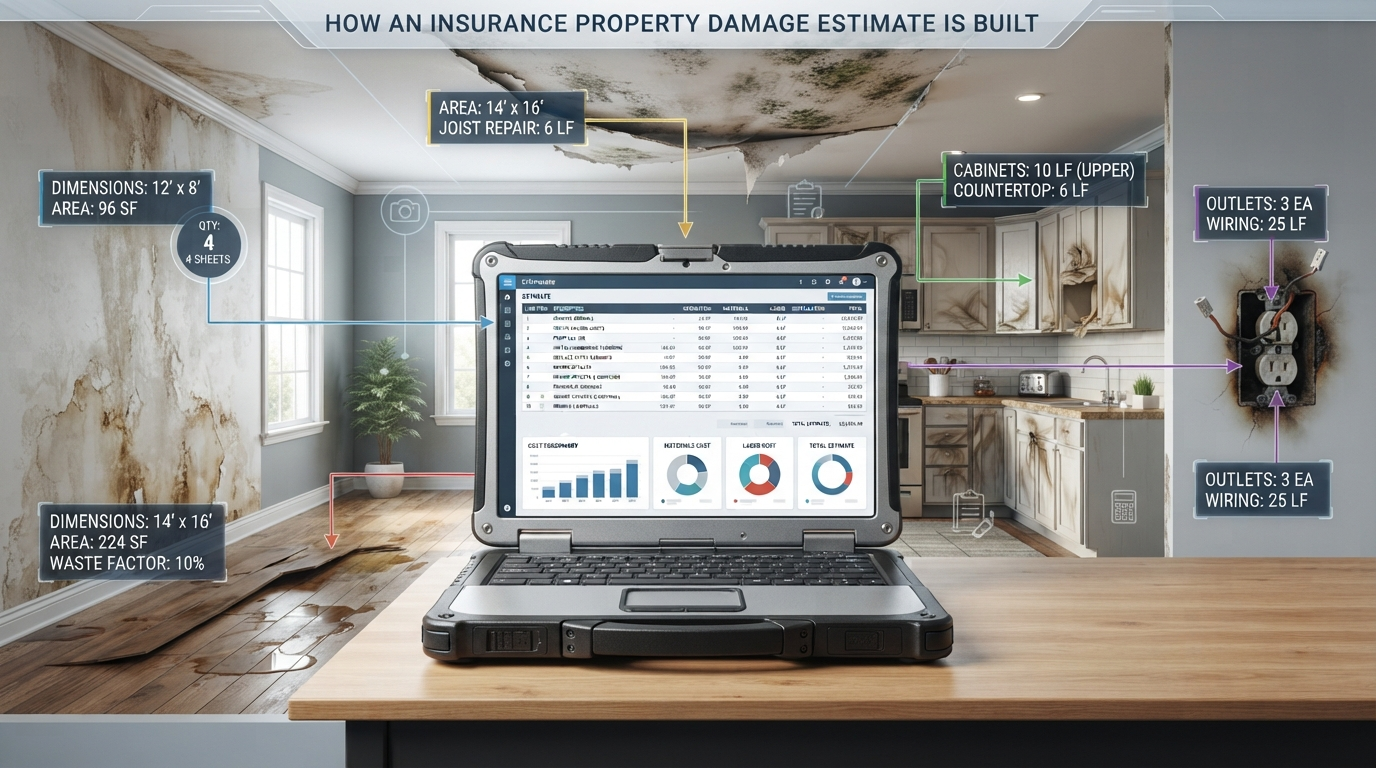
The result is a detailed, line-by-line Xactimate estimate for property damage that carriers can audit, approve, or dispute. Because both the insurance company and the contractor often work from the same platform, negotiations tend to focus on scope (what needs repair) rather than pricing (what things cost) which speeds up the entire insurance claim estimate process.
The Insurance Claim Estimate Process, Step by Step
Whether you’re a homeowner filing a first claim or a contractor managing repairs, here’s how a typical insurance claim estimate process unfolds using Xactimate:
Step 1: Loss Notice and Assignment
The homeowner reports the damage, and the carrier assigns an adjuster or sends an independent estimator.
Step 2: Inspection and Documentation
The estimator inspects the property, takes photographs, moisture readings, and measurements, and documents pre-existing conditions.
Step 3: Estimate Creation
Back at the desk, the adjuster builds the Xactimate insurance claims estimate inside the software, selecting line items, applying depreciation where applicable, and calculating Actual Cash Value (ACV) versus Replacement Cost Value (RCV).
Step 4: Estimate Review and Settlement Offer
The carrier reviews the estimate and issues a settlement offer based on the ACV figure, holding back depreciation until repairs are completed.
Step 5: Contractor Review and Supplementation
This is where many homeowners leave money on the table. A skilled contractor compares the carrier’s estimate against real-world repair needs. If line items are missing say, code-required upgrades, overhead and profit, or overlooked damage the contractor submits a supplement with their own Xactimate insurance claims estimate to justify additional funds.
Step 6: Approval and Repairs
Once the scope is agreed upon, repairs begin, and the contractor invoices against the approved estimate.

Together, these steps create an Xactimate insurance claims estimate that provides a detailed record of the proposed repair costs.
What Homeowners Need to Know
Always obtain an independent Xactimate estimate for property damage from a licensed contractor or public adjuster before accepting a settlement. If your contractor’s estimate is higher, ask them to walk you through the differences line by line. Reviewing the Xactimate insurance claims estimate line by line can help identify differences in scope, quantities, or included repair items. Xactimate reports make this easy because every cost is transparent and itemized. Also, understand your claim policy, including whether you have RCV or ACV coverage, your deductible, and any ordinance or law endorsements that cover code upgrades.
Finally, document everything. Keep photos and videos of all damage, copies of estimates and invoices, receipts for temporary repairs, and records of every communication with your insurance company. This documentation can help support your Xactimate insurance claims estimate if additional damage is discovered during repairs and may provide evidence if you need to request a supplemental payment.
What Contractors Need to Know
For contractors, fluency in Xactimate is no longer optional. It’s a competitive necessity. A properly prepared Xactimate insurance claims estimate gives contractors a standardized way to present the scope and associated repair costs to the carrier.
Key Best Practices for Contractors
- Price with the same database the carrier uses: If your bid exceeds Xactimate’s regional pricing, expect pushback. This helps ensure that the Xactimate insurance claims estimate reflects the appropriate regional pricing database.
- Document scope gaps with photos and code citations: Supplements succeed when they’re evidence-based.
- Include Overhead & Profit (O&P) where justified. Xactimate has built-in line items for this, use them.
- Train your estimators or outsource: A professional Xactimate insurance claims estimate written by an experienced estimator converts far better than a rough draft.
Many contractors handle estimating in-house, but growing firms often find that outsourcing estimate writing frees up field crews to focus on actual restoration work.
Why Accurate Estimating Matters More Than Ever
Material costs have fluctuated sharply in recent years, and labor shortages have pushed wages higher across the trades. An outdated or sloppy estimate can leave thousands of dollars on the table or, worse, put a contractor underwater on a job they already committed to. That’s why accuracy in the insurance claim estimate process isn’t just about fairness; it’s about keeping restoration businesses solvent and homes properly rebuilt.
Get a Professional Xactimate Insurance Claims Estimate from Rebuild Estimator
If you’re a contractor tired of losing evenings to estimate writing or a homeowner who wants an expert second opinion on a carrier’s offer. Rebuild Estimators can help. As a USA-based Xactimate estimating services company specializing in insurance restoration, Rebuild Estimator delivers fast, accurate, carrier-ready Xactimate reports for roofing, water, fire, and storm damage claims. Their certified estimators understand carrier scoping conventions, supplement strategy, and regional pricing, so every Xactimate insurance claims estimate they produce is built to get approved the first time.
Whether you need a full estimate, a supplement, or a re-inspection report, Rebuild Estimator lets you focus on the work while they handle the numbers.
Final Thoughts
Xactimate is the backbone of property insurance estimating in the United States. Homeowners who understand Xactimate insurance claims estimate works for insurance claims are better positioned to challenge lowball offers, and contractors who master the platform win more jobs and higher settlements.
Whether you DIY your estimates or partner with a specialist like Rebuild Estimator, the goal is the same: a fair, accurate, carrier-ready Xactimate report that restores your property and your peace of mind without unnecessary delays or disputes.
FAQs About Xactimate Insurance Claims Estimate
Q: What is an Xactimate insurance claims estimate?
Ans: An Xactimate insurance claims estimate is a detailed, line-by-line estimate of property repair costs created using Xactimate software. It typically includes labor, materials, equipment, and other applicable repair costs based on the property’s location and damage scope.
Q: How does Xactimate work for insurance claims?
Ans: Xactimate works by allowing an estimator to document property damage, take measurements, select appropriate repair line items, and apply localized pricing. The software then generates an itemized estimate for review by the insurance carrier and contractor.
Q: Who prepares an Xactimate insurance claims estimate?
Ans: An Xactimate insurance claims estimate may be prepared by an insurance adjuster, independent estimator, contractor, restoration professional, or other trained estimating professional. The estimator documents the damage and selects the appropriate repair items.
Q: Can a contractor dispute an Xactimate insurance estimate?
Ans: Yes. A contractor can review an insurance estimate and identify differences in scope, quantities, missing line items, or other repair requirements. Supporting evidence such as photos, measurements, invoices, and applicable code requirements can be used when submitting a supplement.